Congratulations to everyone who helped last Saturday with the fundraiser.
We managed to raise just over £750!!!
Thursday, 24 April 2014

Friday, 10 January 2014
Press Relaease
Please click the link below to review our latests press relaease:
http://www.yorkpress.co.uk/sport/10925553.Medals_success_for_York_karate_clubs/
http://www.yorkpress.co.uk/sport/10925553.Medals_success_for_York_karate_clubs/
Monday, 18 November 2013
Article by Simon: Big clubs must accept a poor standard in order to make money
Following on from my last article about business in karate,
I thought I would write about another issue that arises from what you might
call commercial karate. How big should a karate club be and how many members
should a club have.
The misconception
Let’s address the misconception first. The misconception is
that a commercial karate club, for clarity this is a club where one or more of
the instructors are paid a salary or the club owner lives off the proceeds of
the club, must do everything within its power to attract new members and do
everything possible to hold on to them. This is because the club is profit
focused, apparently, and so cannot afford to lose members. This means large
class sizes, belts given out like candy and consequently, a poor standard. The
shame is that there are clubs run in this way but you might be surprised to
learn that this is not in the commercial interests of the club nor is it
restricted to commercial clubs.
The economics
As an economics graduate I tend to approach such issues from
an 'economics' perspective. The issue here is economies (or diseconomies) of
scale. A basic concept in economics that makes common sense. Simply put, the
larger a business grows, from the point of view of revenue, the lower the ‘per
unit’ cost. This is simply due to some costs being fixed (hall hire for
example) and an increase in purchasing power (you get more discount on buying 100
suits than only buying 1 and so you can make more profit per karate suit). This is
known as economies of scale and will tend to lead to companies in almost any
sector to grow and expand. The incentives and advantages to larger businesses
will mean the ones that fail to grow will no longer be able to compete and so
will go out of business.
However, this advantage is almost exclusively financial but
not necessarily best in other areas. What about standards, customer service and
trust. We see that alongside economies of scale we have diseconomies of scale.
As a company gets larger it often fails in connecting to customers (as there
are so many of them!) and so the quality of care or service will fall, overall
standards are likely to slip as the business struggles to monitor and
communicate internally and all of this leads to the customer feeling that they
are not receiving the standard and quality of care expected.
Of course, a customer may be willing to overlook some of
this as the larger company will offer a better price (financial) even though they
receive a substandard service. Research has shown consistently that human
beings are very poor at considering choices in financial terms and so will
regularly make decisions that are based on other, perhaps aesthetic, concerns
rather than price. Think about Apple. Their products are horrendously expensive
and often inferior from the point of view of pure technical power. However,
they do have an appealing nature, a beauty in design and a creative ‘something’
that appeals to many fans. They are also excellent and fostering brand loyalty
(although most certainly not from this writer).
Back to the dojo
All of this has implications for a karate club, both
commercial and non-commercial. If we know that customers are often more
interested in ‘other things’ than in the price when making commercial
decisions, we immediately recognise that a large membership base is not necessarily the
answer to running a successful karate club. The point being that the members
should not feel like they are a part of a large club but a small, friendly club
that offers excellent instruction. However, you need to make a sufficient
income at the same time and so the answer is simple. Small class sizes but many classes. This is not the best way to run
a business when looking at ‘per unit’ costs but it is actually the best way to
run a business commercially. You will have higher levels of satisfaction,
better customer service and higher standards caused by improved instructor to
student ratios. Your retention will go through the roof and your numbers grow, facilitating higher profit despite the extra cost of running more classes.
I am always amazed how many commercial karate clubs don’t get this point. JKS
York Karate Club (my club) has a class target size of 20 per class for over 8’s
and 15 for under 8’s. If this target is breached we stop accepting new members
or we add additional classes. Remember, the quality of your classes, students
and teaching IS your brand. Make
your brand a quality, luxury brand and people will flock to your club. Make it
cheap, tacky or fake and watch everyone give your club a wide birth. The
average Joe doesn't know much about martial arts but they will see straight
away if your club is of a poor standard and belts given out easily and cheaply.
Your reputation in the community will not last long.
Now here is the surprising thing. It is non-commercial
karate clubs who often fail to grasp this point. I have trained in packed dojos
with over 30 or 40 members and a single instructor. Non-commercial karate clubs
do not necessarily think about, or assess the workings of their club, from the
perspective of marginal costs, customer satisfaction and projected growth - they
should! (In a similar way to a charity or school). However, I do wonder if for
certain instructors there is a certain ego boost that is received from standing
at the front of a large class. Such an ego boost might massage the instructor’s
vanity but does not help the club, the club members or karate. And in fact, is
ultimately detrimental to the instructor themselves.
Of course, I am talking here about the day-to-day running of
a club. It is entirely appropriate, given the exceptional skill and talent of a
top instructor, and in consideration of their high marginal cost, to run a one
off seminar with a top instructor and have many people in attendance. It simply
isn't possible most of the time to have a high profile instructor teach a class
of only 20 or 30 people.
Large, commercial clubs can, therefore, actually be of a
very high standard and run in a way that ultimately makes commercial sense. It
is not the case that you must accept lower standards of karate in order to be a
financial success.
Thursday, 31 October 2013
HAPPY HALLOWEEN

Happy Halloween from JKS York Karate Club
We had a great training session on Tuesday with everyone dressed in their scary outfits. We covered the basics; how to defend yourself from a brain munching zombie, an unstable walking skeleton and a blood sucking vampire. Our little dragons should be more than safe on the streets around York tonight!
Tuesday, 15 October 2013
Morning Training
Starting tomorrow, training 7:30am - 8:30am at Shipton community centre every Wednesday. Open floor session so no teaching but you can use the space for fitness, kata practice, sparring with a partner - whatever you like. Free for club members, non-club members £2.00. (Yes, it is AM!!! In the morning!!!)

Monday, 14 October 2013
Full-time, part-time or hobby?
I thought I would write my first personal post on a subject that gets me very... motivated - simply because there is a great deal of nonsense spoken about it within karate circles. Is it best to teach karate as a full-time instructor, part-time or just as a hobby (something you do 2 or 3 nights a week after work and presumably unpaid).
Let me come at it from the opposite angle and ask how much time do you need to invest in order to teach karate?
I am afraid that I have attended far too many classes where the instructor has simply turned up and 'made it up' as he goes along. This is poor teaching as the class has no focus, no structure, no overall aim and no direction. If this is the extent of the planning for every class then you really are flying blind and if you happen to learn everything you need to pass shodan then it is more down to fortune than planning. Classes do not need to be micro-planned to the very minute but there must be a structure per class that fits into an overarching structure per grade that fits into a general structure for the whole syllabus. Planning, then, is at the heart of good teaching but it takes time. You also require time to review and reflect on each lesson.
Running a club is something that cannot be done by just 'turning up' twice a week to the dojo. The time required to build and maintain websites, reach out to the local community through schools and other establishments, and also providing sufficient opportunities for your members to train (everyone lives a hectic lifestyle and is looking for what fits their life, not what fits your life) requires you to provide many classes and work hard outside of the dojo.
In a nutshell, to run a well oiled club you need time. Now yes, if you have a club of only 30 members and you have no intention of ever expanding beyond this, you can run an amateur, make-do club and probably find a way to get by. You may even produce one or two excellent karate-ka and everyone who attends may have fun. But... is this the best system?
Now, I am not saying that there are not problems with full-time instructors too but I do think that full-time instructors can offer more to their students in principle. They have the time to spend on their own training, be it attending courses, visiting other clubs to train and thinking about, reading and watching karate. They can also spend their time planning their classes, thinking about their student development and offer more of their time to their students. They can also use their time to prepare websites, materials, videos and other 'out of dojo' resources that can enhance their student's training and improve the overall functioning of the club. Also, this is a big one, they can turn up to class refreshed and full of energy, not drained after a hard day's work.
Of course, as I say, there are problems. For example, just because a full-time instructor does have the time to do all of the above, it does not mean that they do. In addition, there is the thorny issue of money! An instructor I much admire said to me once 'behind every argument in karate ultimately lies the issue of money.' I think he is on to something with this although I would also add power/ego.
The full-time instructor, if they own the business/club, will always have the pressure of revenue and cost to deal with. The problem, however, is profit. There are things you can do to increase profit and reduce the standard and credibility of your club (e.g. giving away black belts too easily, quickly or cheaply). The allure of money can corrupt the full-time instructor if profit comes before their training and karate principles.
Part-time is, in my opinion, the worst of both and the best of none.
The answer - it depends entirely on the individual. There are good instructors who do their teaching as a hobby and there are good full-time instructors who are not out to rip you off!
There is one thing for sure - no one can claim that one way is better than the other.
Simon
(I should declare that I am a full-time instructor.)
Tuesday, 8 October 2013
Blog Authors
I have been added as a blog author so that you can distinguish between 'official' club posts, which will appear as JKS York Karate Club and posts under my own name which represent my personal thoughts, ideas and views about karate. I know that some of you might be interested in hearing what I have to say about karate. I will also start to post personal videos of me teaching and training, as well as interviews and other media.
See you soon!
See you soon!
Grading Course with Sensei Matt Price
We are very fortunate to have Sensei Matt Price visiting our club on the 15th December 2013 to deliver a training and grading course. Sensei Matt is both an excellent instructor and a fine karateka and I, for one, am looking forward to the course.
It is an open course and so you do not need to be a member of the JKS to attend. Everyone is welcome - it will be a great day!
As ever, if you wish to grade on the course, please register on our website www.yorkkarate.net in advance.
If you are just training, you can pay on arrival.
Osu!

It is an open course and so you do not need to be a member of the JKS to attend. Everyone is welcome - it will be a great day!
As ever, if you wish to grade on the course, please register on our website www.yorkkarate.net in advance.
If you are just training, you can pay on arrival.
Osu!

Monday, 2 September 2013
York success at the LKA competition
JKS York Karate had a great day at the Leedsa Karate Competition yesterday by claiming two medals in the kumite discipline and a fourth in kata.
Only a small squad of 4 attended the competition but they didn't let the club down. Everyone tried hard in the kata and both Ellis and Owen made it past several rounds before finally being knocked out (by more experienced competitiors). Ellis made it all the way to the last four and only narrowly lost out on a bronze medal.
The team did even better in the kumite. Amy has a tough fight against a much taller opponent in the last four which shook her a little. However, I was very impressed with the way she pulled herself together for the 3rd place play-off and she totally outclassed her opponent to win the bronze medal. Well done!
There were only two fighters in Owen's category so only gold would have done. Owen is showing real improvement in his kumite and demonstrated a level of skill, composure and class that i haven't seen before. Whilst his opponent did his best, in all fairness Owen was simply a level above him and deservedly claimed gold. Well done to both Freddie and Ellis who were frustrated at not progressing but that is why these club competitions are so useful for gaining experience and understanding in how karate competitions work.
The big one is next - JKS England nationals in November!
Osu
Simon


First 'Karate Star' winner - Ivy
Ivy has won the first Karate Star trophy for her excellent performance. This was topped off with her being the first student to be able to do the side splits at the club. Well done Ivy - keep up the good work!
Remember, you too could be a 'Karate Star'. More stars will be handed out in September to those students who show excellent attitude, performance, dedication and effort.
The side split challenge is still open so keep stretching.

Remember, you too could be a 'Karate Star'. More stars will be handed out in September to those students who show excellent attitude, performance, dedication and effort.
The side split challenge is still open so keep stretching.

Wednesday, 14 August 2013
Monday, 5 August 2013

Wednesday, 3 July 2013
St Peter's School is latest School to work with JKS York Karate
I am pleased to confirm that St Peter's School will be working with JKS York Karate Club to provide karate classes for their pupils. Classes will initially be for those who attend the Clifton Pre-prep school with plans to make the classes more widely available in the future.

The JKS York School Karate program is the largest such program in York with a total of 7 schools across the area involved.

The JKS York School Karate program is the largest such program in York with a total of 7 schools across the area involved.
Monday, 1 July 2013
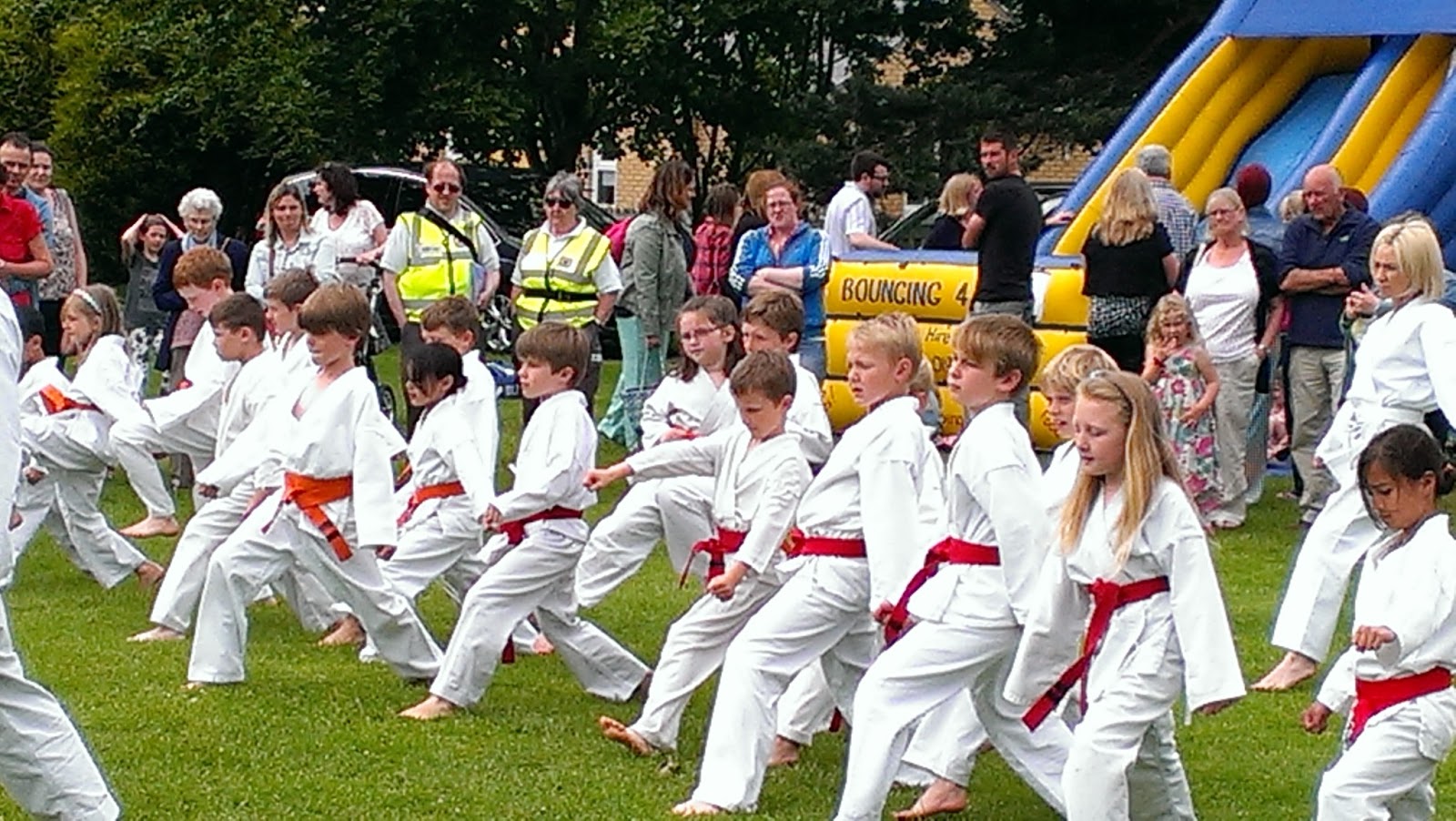
Wigginton School Demonstration
Thank you to everyone who attended the school demonstration last Saturday. It was great to get out of the dojo and show the general public what we get up to when we train. Also, thank you to Wigginton Primary School for inviting us to do the demonstration.
It was, for many, their first ever demonstration and I thought everyone did great!
One more to do this Friday, at Ralph Butterfield School. 6pm. See you there.
Simon
Instructor
Thank you to Mhairi (George's mum) and Gemma (Alex's mum) for the photos.


It was, for many, their first ever demonstration and I thought everyone did great!
One more to do this Friday, at Ralph Butterfield School. 6pm. See you there.
Simon
Instructor
Thank you to Mhairi (George's mum) and Gemma (Alex's mum) for the photos.


Thursday, 6 June 2013
New Club Shop open!
The new, online, club
shop is open and ready for business. You can now order your karate suits with
the club logo embroidered. T-shirts going on sale in the next few days :)
http://www.yorkkarate.net/#!club-shop/c1pta
http://www.yorkkarate.net/#!club-shop/c1pta
Club T-shirts
Please email me with your preference on colour. We will probably pick two colours from the choices below to go with.
info@yorkkarate.net


info@yorkkarate.net


Tuesday, 4 June 2013

Grading course
Congratulations to all 41 members of JKS York karate club who passed their grading exams last Sunday.
A special mention to Ivy who double graded. Well done!


Change to class times / class cancelled
Please note that the new training times come into effect
from today.
5:30 - 5:45 - Little dragons warm-up/games
5:45 - 6:30 - Little dragons training
6:30 - 7:30 - White, orange and red belts
7:30 - 8:30 - Yellow belts and above.
PLEASE BE REMINDED THAT THERE IS NO TRAINING THIS THURSDAY
Tuesday, 28 May 2013

Subscribe to:
Posts (Atom)